Northern Pike: Complete Species Guide
The northern pike is the apex predator of America's northern lakes — an ambush hunter with a mouth full of needle-sharp teeth and a reputation for smashing lures that bigger bass only dream about.
Northern pike fishing is a rite of passage across the northern tier of the US, from New England to Alaska, and the fish grow big enough to test any angler's tackle.
This complete species guide covers how to identify a northern pike, its behavior and habitat, what it eats, how big it gets, and the basics of catching one. New to fishing? Our fishing for beginners guide covers the fundamentals — and northern pike are a surprisingly forgiving first trophy for beginners who come prepared with the right gear.
What Is a Northern Pike?
Northern pike (Esox lucius) belong to the pike family (Esocidae), a small group of freshwater predators that also includes the muskellunge and several pickerel species.
It's one of the most widely distributed freshwater fish on Earth, native across the Northern Hemisphere from North America through Europe and Asia. Wherever it lives, it fills the same role: the top of the food chain.
Several nicknames capture its personality. "Water wolf" is the most common, and it fits — pike are solitary, patient, and viciously efficient. European anglers simply call it the common pike, while northern anglers often shorten it to "gator" after seeing one explode on a topwater lure.
Three traits make it one of the most popular game fish in the North:
- Aggression. A pike doesn't nibble — it hits hard enough to rip a rod out of a holder. It's the same explosive ambush style that makes bass fishing so addictive, amped up for a fish twice the size.
- Size. They're the largest toothy predator in most northern lakes, with trophies stretching past 40 inches.
- Accessibility. Pike live in thousands of lakes, rivers, and ponds, bite year-round (including through the ice), and will hit everything from spoons to live bait.
Northern Pike Identification: How to Tell Them Apart
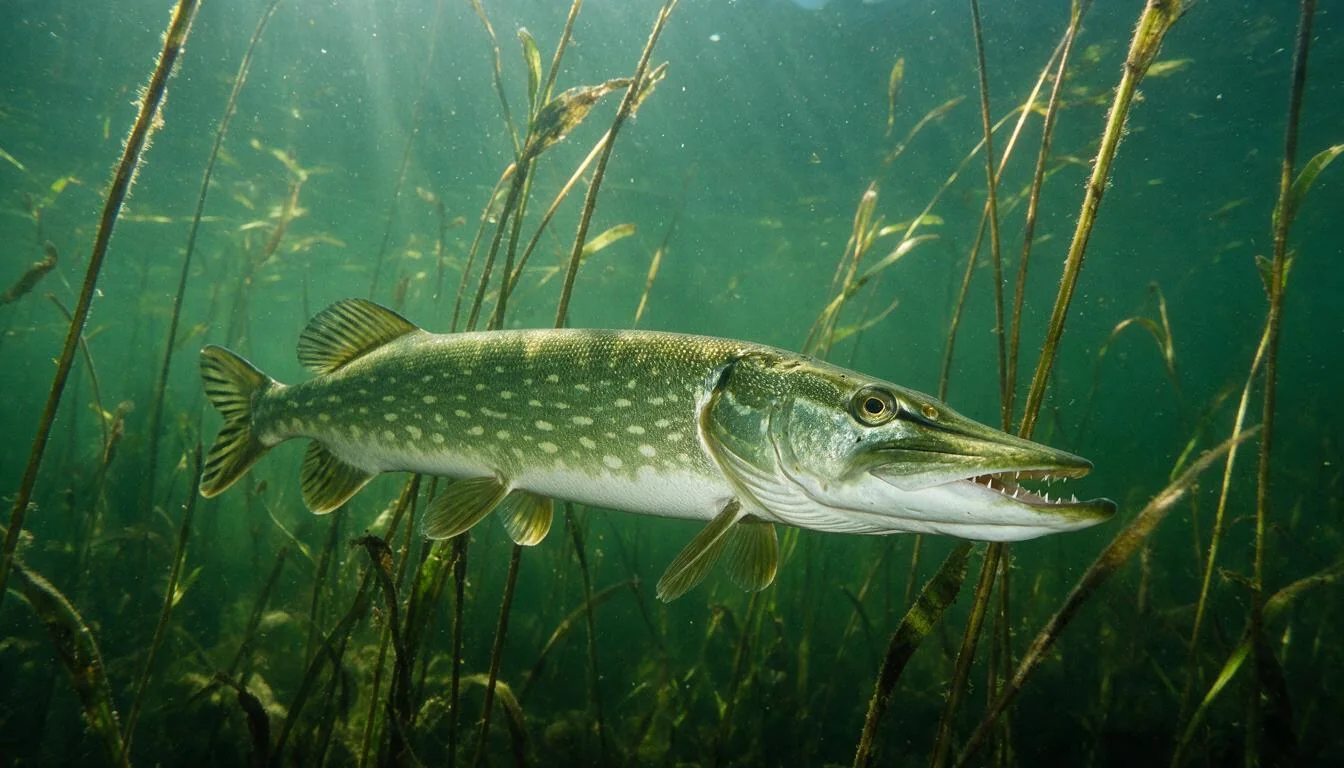
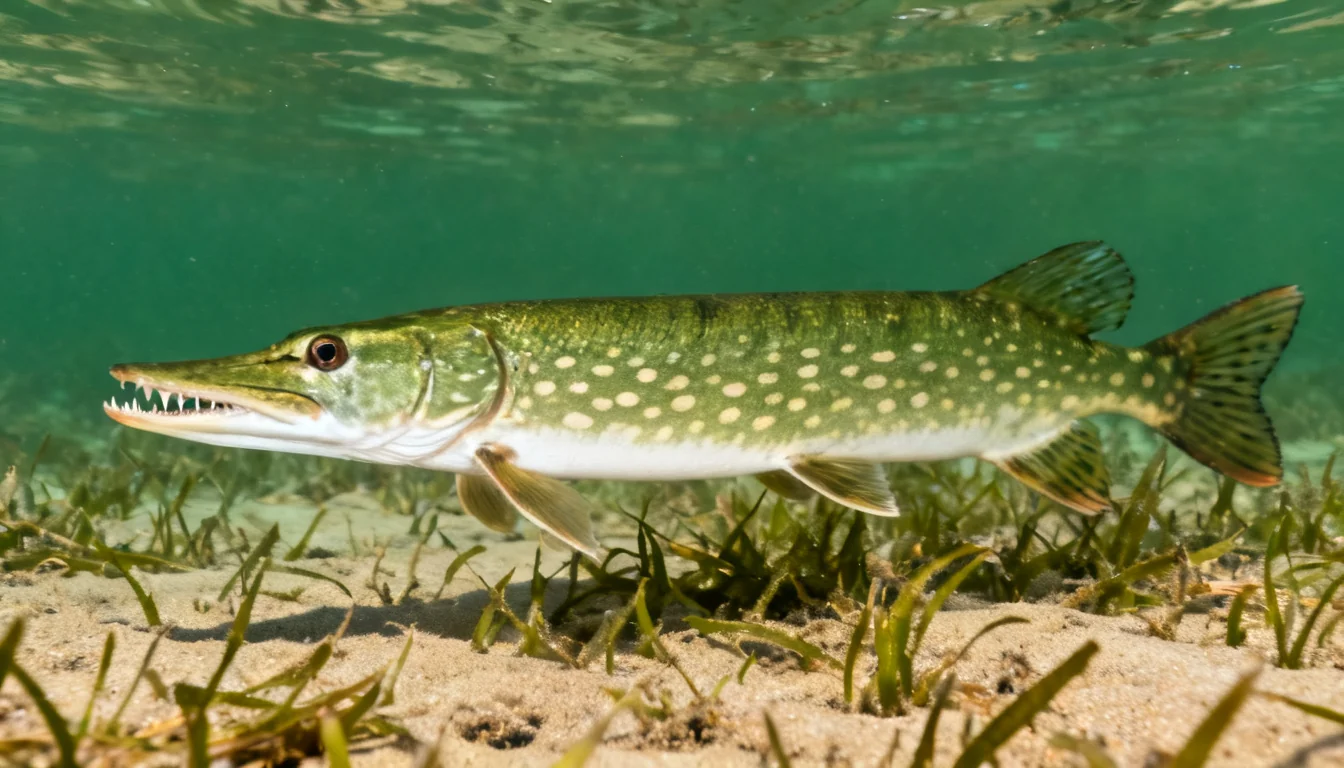
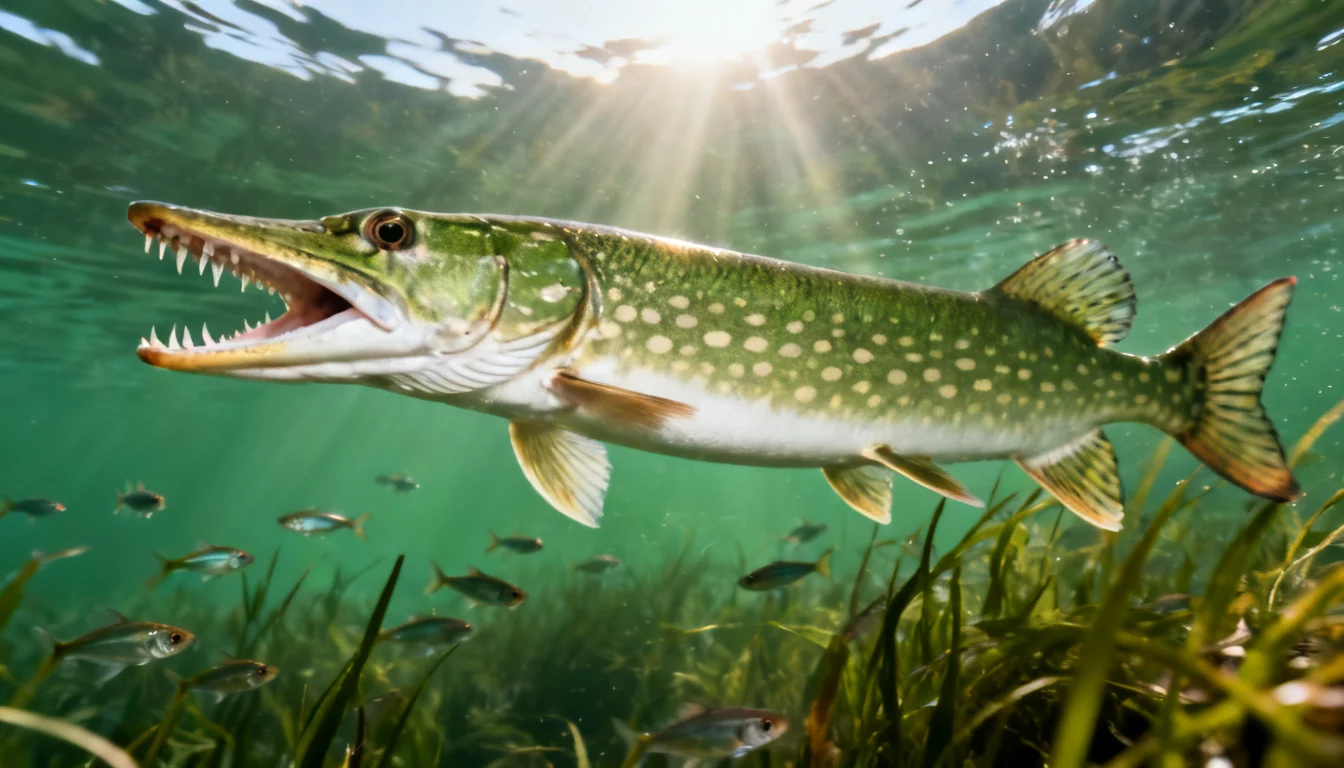
Northern pike identification starts with the silhouette: an elongated, torpedo-shaped body, a long flattened snout that looks like a duck's bill, a single dorsal fin set far back near the tail, and a forked tail. The mouth is packed with hundreds of needle-sharp, backward-curving teeth — including rows on the roof of the mouth and tongue — so anything swallowed is not coming back out.
The body color is the key field mark: pale, bean-shaped spots scattered over a dark green-olive background, fading to a cream or white belly. Pike in clear, dark-bottomed lakes run darker; fish from weedy, stained water are brighter. Either way, the spots run in rows along the flank rather than the vertical bars of a muskellunge.
| Feature | Northern Pike | Muskellunge | Chain Pickerel |
|---|---|---|---|
| Body pattern | Pale spots on dark green | Dark bars/spots on light | Chain-link pattern |
| Tail lobes | Rounded | Pointed | Pointed |
| Cheek scales | Fully scaled | Upper half only | Fully scaled |
| Lower-jaw sensory pores | 5 or fewer per side | 6 or more per side | Fewer than 5 |
| Typical size | 24-36 in | 30-50 in | 15-24 in |
The quickest field test is the spots: if the pattern is pale-on-dark, it's a pike; if it's dark-on-light, you're looking at a muskie. Pike also share water with walleye and perch in many lakes — a glance at the single rear dorsal fin separates a pike from those two-dorsal species instantly.
Northern Pike Behavior & Habits
Everything about a pike's life is built around ambush. Adults are solitary, each fish claiming a stretch of cover and lying motionless inside it, often for hours, waiting for something edible to swim past. When it strikes, it's a single explosive burst — the pike grabs the prey sideways, turns it head-first, and swallows it whole.
Feeding windows: pike see best in low light. Dawn, dusk, and overcast days are the classic bite times, and in clear lakes the fish are noticeably more active at night. In spring, when the water is still cold and stained, pike will feed all day.
Spawning: pike are among the earliest spawners in freshwater. Within days of ice-out, when water temperatures hit the low-to-mid 40s (°F), they move into flooded marshes, weedy bays, and shallow backwaters to scatter eggs over vegetation. No nest is built, and no parent guards the young — the fry simply grow up eating each other and everything else that fits.
| Season | Where They Are | What They're Doing |
|---|---|---|
| Spring | 2-6 ft, flooded weeds and shallow bays | Spawning, then a hungry post-spawn feeding binge |
| Summer | Weedlines and 8-20 ft, cooler water | Sluggish by day; active dawn, dusk, and night |
| Fall | Shallows again, chasing baitfish | Feeding binge — the best big-fish window of the year |
| Winter | Under ice, on weedy flats and edges | Still feeding — a classic ice-fishing target |
Cannibals: big pike eat smaller pike without hesitation, and they'll take any prey up to roughly a third of their own length. That appetite is why pike waters stay full of medium-sized fish — the big ones are too busy eating the little ones to overpopulate.
Northern Pike Habitat: Where They Live in the US
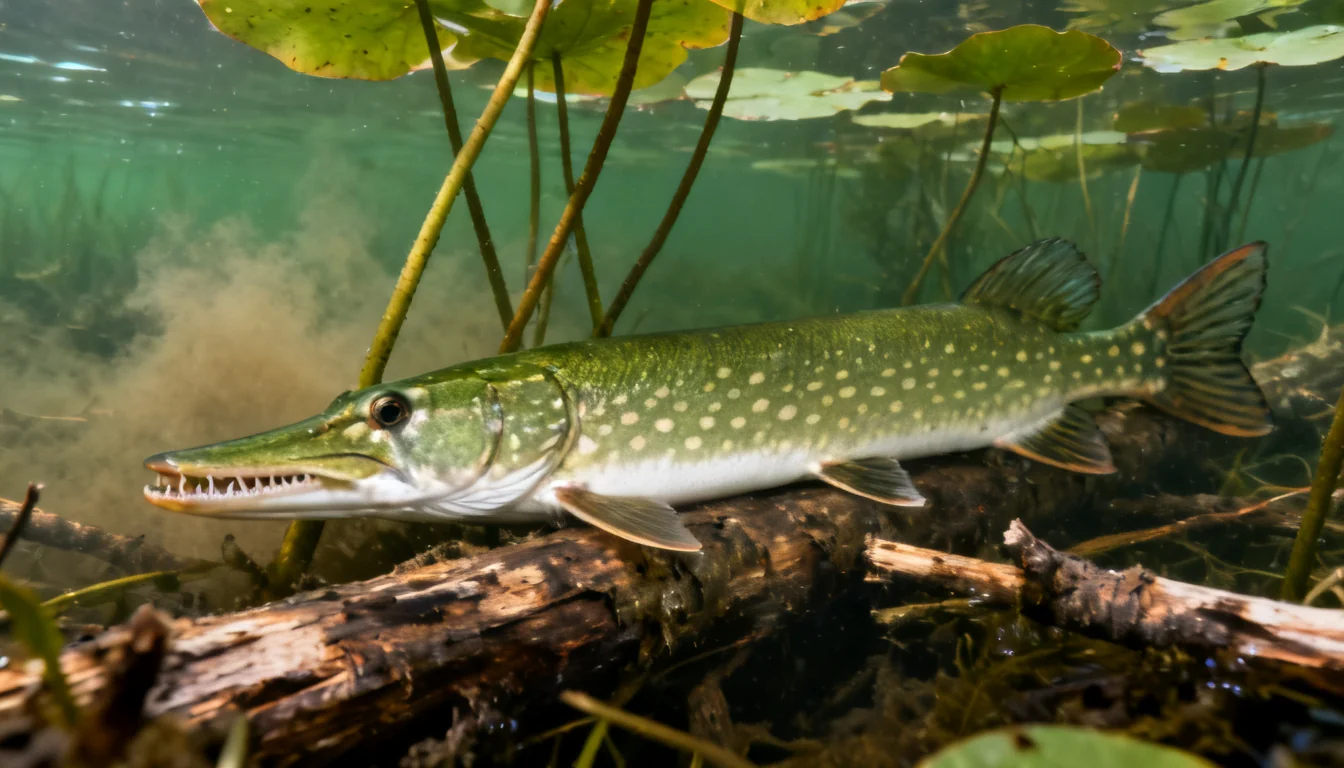
Northern pike habitat comes down to two words: cool and weedy. Pike are fish of lakes and slow rivers, preferring backwaters, bays, and marshy shorelines where weed beds, lily pads, and flooded timber give them cover to hunt from. They rarely roam far from structure — a pike's whole world is the edge of the weeds and whatever swims past it.
In the US, pike are native across the northern tier: New England, New York, the Great Lakes states (Michigan, Wisconsin, Minnesota, Ohio, Pennsylvania), the Upper Midwest, the northern Plains, the Rockies, parts of the Pacific Northwest, and Alaska.
Their native range ends roughly at the latitude of the Ohio and Missouri rivers — they're absent from most of the South, where the water simply runs too warm.
A few things worth knowing about where pike live:
- Water temperature: pike are most comfortable between about 50 and 72°F. They handle near-freezing water fine — that's why ice fishing works — but when summer heat pushes a lake past the mid-70s, pike slide deeper and shut down during the day.
- Depth: most pike are caught in 2-10 feet of water near cover, but summer fish often hold deeper — on weedlines and drop-offs in 8-20 feet where the water stays cool.
- Introduced populations: pike have been stocked or accidentally introduced in some western lakes where they're not native — in a few of those waters (like California's Lake Davis) they're managed as invasive, and eradication programs have been fought over them. Check your state's regulations: in some waters, anglers are actually encouraged to keep every pike they catch.
What Do Northern Pike Eat?
What do northern pike eat? Almost anything that moves. Pike are opportunistic ambush predators, and their diet reads like a menu of the entire northern ecosystem:
- Fish — perch, suckers, cisco and whitefish, shad, minnows, and other pike make up the bulk of the adult diet
- Frogs and salamanders — a warm-water bonus in spring and summer
- Crayfish and leeches — snapped up off the bottom when nothing better swims by
- Small mammals and birds — mice, voles, ducklings, and even small muskrats are taken when they cross open water
Because pike feed so heavily on baitfish, the standard rule applies: find the bait, find the pike. In summer, pike position themselves beneath schools of perch and suckers; in fall, they follow shad and cisco right back into the shallows.
A pike's hunting range is small — most of its life happens within a few hundred yards of one favorite weed bed.
How to Catch Northern Pike
Pike are aggressive and relatively simple to catch — once you solve the two problems they present: their teeth and their home turf. The complete playbook is in our companion guide, How to Catch Northern Pike, but the short version looks like this:
- Always use a wire leader. Pike teeth slice through monofilament and braid like thread. A 6-12 inch steel or titanium leader is not optional.
- Throw big lures. Large spoons, spinnerbaits, and jerkbaits in the 4-7 inch range match the baitfish pike chase.
- Fish the weeds. Cast to weed edges, lily pads, and flooded timber in 2-10 feet of water — and slow down. A slow, steady retrieve beats a fast one almost every time.
- Spring and fall are prime. Post-spawn spring and the fall feeding binge are the two windows when pike are easiest to catch from shore or boat.
Northern Pike Size: How Big Do They Get?
Northern pike size depends mostly on latitude and food supply — pike grow slowly in cold northern waters but keep growing for decades, which is why the biggest fish come from the coldest lakes.
- Typical catch: 24-36 inches, 3-10 lb — the everyday pike most anglers boat
- A solid fish: 30 inches and up; a 10-pounder is a good day in any state
- A trophy: 40 inches or more, roughly 15-20 lb depending on body condition
Females grow faster and larger than males, and a 20-pound pike is an old fish — often 15 to 25 years old in northern lakes.
The IGFA all-tackle world record for the species is 55 lb 1 oz, set at Lake of Grefeern, Germany, in 1986.
American state records are almost as impressive: New York's record is 46 lb 2 oz from Great Sacandaga Lake (1940), and Minnesota's is 45 lb 12 oz from Lake of the Woods (1929). Most other northern state records fall somewhere in the 25-40 lb range.
Are Northern Pike Good to Eat?
Yes — if you don't mind a few bones. Pike fillets are white, firm, and mild, and the fish is treated as a delicacy in Europe, where it's been eaten for centuries. The one obstacle is the Y-bones: a row of small, Y-shaped pin bones runs through each fillet, and they make a simple fillet a project.
Two solutions exist, and both are worth learning: the five-fillet method, which removes the Y-bone section cleanly, and good old-fashioned pickling, which dissolves the bones entirely. Pan-fried pike fillets, pike cakes, and baked pike all have devoted fans across the northern states.
See our pike recipes collection for the full bone-removal and cooking walkthrough. One tip: skin big pike and trim the dark lateral-line strip — older fish from warm, muddy lakes can taste strong otherwise.
Northern Pike FAQ
How long do northern pike live?
Most pike live 10-15 years, but in cold northern lakes they commonly pass 20, and individuals over 25 years old have been documented. Because growth is slow in cold water, a big pike is usually an old pike — one reason trophy pike waters are managed carefully.
Can a northern pike bite you?
The teeth can certainly cut you — they're sharp enough to slice line and flesh — but pike don't attack people. Bites happen during careless handling: gripping a live pike's head can put your hand in the tooth zone. Grip firmly behind the head over the gill plate, keep fingers out of the mouth, and use pliers for hook removal.
What is the biggest northern pike ever caught?
The IGFA all-tackle world record is 55 lb 1 oz, landed by angler Lothar Louis at Lake of Grefeern, Germany, in 1986 — a mark that has stood for four decades. In the US, New York's 46 lb 2 oz fish from Great Sacandaga Lake (1940) and Minnesota's 45 lb 12 oz from Lake of the Woods (1929) remain the two most famous state records, and both still stand today.
Are northern pike invasive in some states?
In a few western waters where pike were introduced or escaped, yes — they're managed as an invasive species. California's Lake Davis is the famous example: the state treated the lake with rotenone in 1997 and again in 2007 to wipe out the illegal pike population. If you fish a water where pike are non-native, check the regs — many such lakes have no size or bag limits, and keeping pike is encouraged.
Do northern pike bite in summer?
They bite, but the timing shifts. Summer pike hold deep on weedlines and drop-offs during the day and feed at dawn, dusk, and night. Fish the same weed edges early and late, go deeper for midday fish, and slow your retrieve — in warm water a pike would rather ambush a slow meal than chase a fast one.
The Bottom Line
The pike is the top predator of the northern lake — a toothy, solitary ambush hunter that combines bass-like aggression with muskie-level size potential. Identify it by the pale spots on dark green, find it in the weeds of cool northern lakes, and catch it with big lures and a wire leader.
Spring and fall put pike shallow and hungry; summer and winter just mean adjusting depth and pace. It's a fish that rewards preparation — and once you've watched a 40-inch water wolf crush a topwater bait, you'll understand why pike fishing has a following that never quits.